

Models got really good, really fast. But, ask one anything specific about your business and watch it guess based on very limited knowledge it has.
That’s a context problem, not a model problem and real work runs on context — who actually makes the call on a deal, what your team’s priorities shifted to last week, why something closed in March even though the handshake happened in January. None of that lives in any one tool. It’s scattered across CRMs, threads, tickets, and people’s heads. So it answers from fragments, and you stop trusting it.
Tom Blomfield at YC posted about the emergence of a new primitive: the company brain. A system that turns a company’s scattered context into something AI can actually use.
Our thesis is similar but nuanced: every function inside a company needs its own brain. Joni Helminen, the CMO at Barona, is building one for marketing.
We’re building the brain for revenue in Clearksies — the context layer for Revenue AI.
The demand is already showing up
You don’t have to argue this is coming.
Foundation Capital published a thesis calling “context graphs” a trillion-dollar category. Aaron Levie put it more directly: “The future of agents is a race to who can provide them with the best context.” That’s the investor view.
The customer view is louder. On a sales call a few weeks ago, the Director of RevOps at a fast-growing software company said this without prompting: “More and more I think we’re gonna see products where the model instead is plugged into everything, and then you have the 360 view that you want.” He hadn’t read any of our materials. He’d just hit the wall using individual connectors enough times that the answer was obvious.
Joni walked through his on LinkedIn last week. Markdown files he writes in his evenings, a GitHub + Claude setup of skills and MCPs any team member can connect to. He calls it the Marcoms Brain. His take: “The moat isn’t the AI. It’s the structured business context that feeds it.”
Same pattern every time. Smart operators are building this by hand because nothing builds it for them. That’s market signal.
One brain isn’t enough
The company brain framing is right but incomplete. No single team owns it. The real work happens inside each function.
Marketing’s brain isn’t the same as Revenue’s. Revenue’s isn’t the same as Customer Success’s. The data overlaps — every function reads from the same underlying customer data — but the jobs each one is doing don’t. Same data, different decisions, different definitions of “good.” That’s where the design work lives for each function. A marketing brain knows campaigns, brand, and audiences. A revenue brain knows sales process, decision making, exceptions, and all the nuances that make up the revenue function. Same substrate, but just tuned for different jobs.
The pattern repeats across every function, and the team that’s most painfully stuck tries to build in house first. A head of product at a fintech built a 250,000-token XML dossier of every account because every AI workflow he wanted needed the same context. A Director of Sales at a SaaS company runs a “Frankenstein” prompt across Sheets, SQL, and Claude to help his AEs prioritize. Joni built his in markdown. Three power-users, three different functions, one shared instinct.
Clearskies is the Revenue Brain
We’ve been building this for revenue teams. Three layers of context every revenue org needs:
Customer context — every interaction with every customer, across CRM, calls, email, calendar, and Slack. Identity resolved across sources, with a timeline of every touch.
Process context — how your team actually sells. Objection handling, negotiations, pricing discussions, methodologies, and sales enablement.
Business context — your team, your numbers, your priorities. What “winning” looks like at your company this quarter.
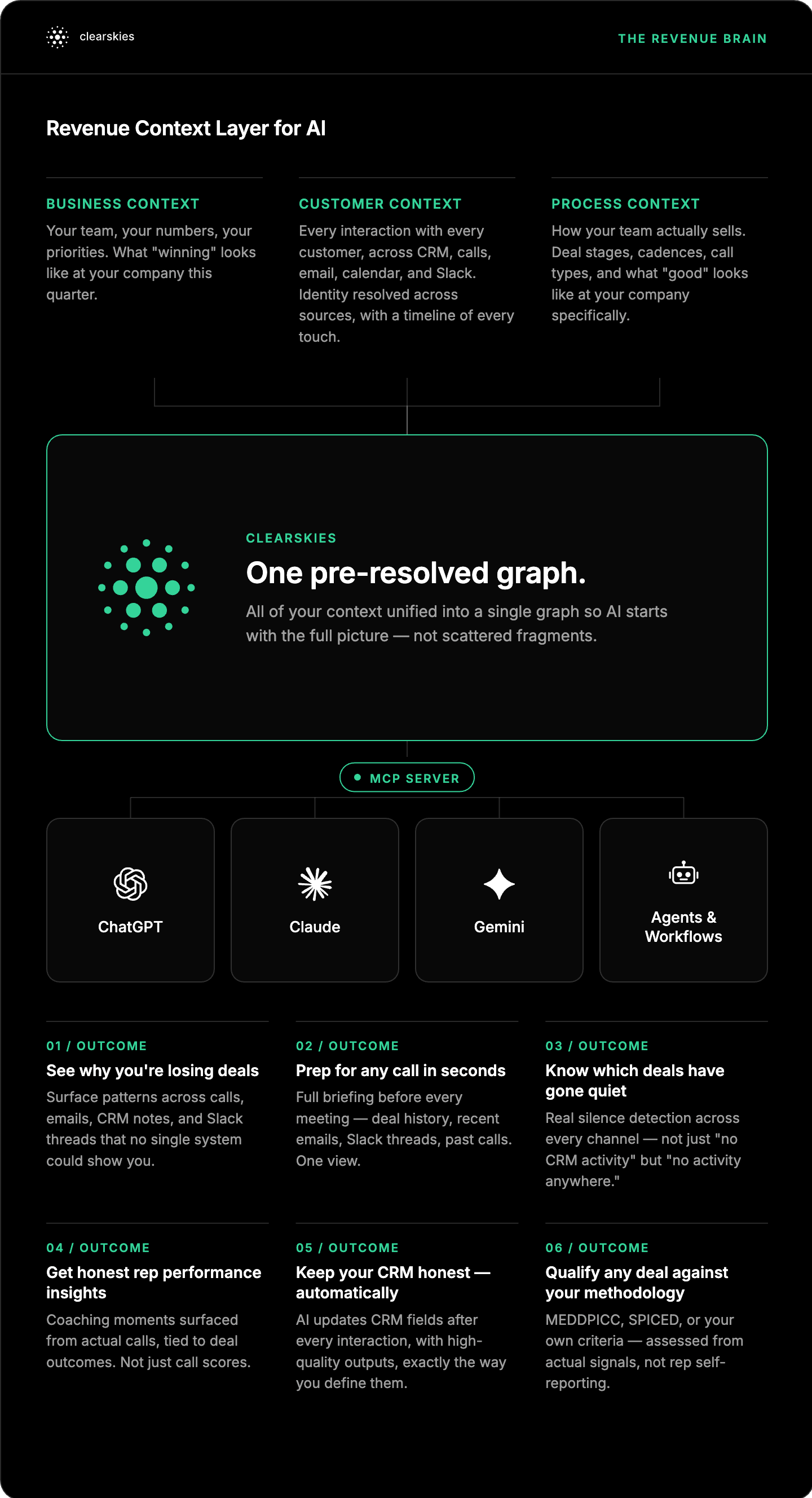
That’s the Revenue Brain. The context layer underneath every AI workflow your team would actually want to deploy. Without it, AI rebuilds context from scratch on every query and answers from one source at a time. With it, agents actually work — pre-call briefs that pull deal history, recent emails, Slack threads, and past calls into one view; pipeline reviews built on what’s really happening across every channel; and win-loss that surfaces patterns across calls, emails, CRM notes, and Slack that no single system could show you. The same context layer tells you which deals have gone quiet across every channel (not just “no CRM activity”), surfaces coaching moments from actual calls tied to deal outcomes (not just call scores), qualifies any deal against MEDDPICC, SPICED, or your own methodology from actual signals (not rep self-reporting), and keeps your CRM honest by updating fields after every interaction exactly the way you define them.
That’s customer context at work. Business context provide even more: Monday-morning briefs that synthesize what changed last week, forecast checks calibrated against your actual deal patterns, QBR prep pulled from every system without a human in the loop.
And, process context is what lets agents follow your team’s actual playbook — flagging deals that drift from how you win, coaching ramp reps against your specific methodology, building reports around your real categories instead of a generic taxonomy.
The moat compounds
Companies aren’t asking “should we use AI?” anymore. They’re asking “how can I make this work for my use case?” or “How can we make AI actually useful for our sales team?” The answer is the same every time: it doesn’t have the context.
Joni’s prediction applies to every function: “Within 12 months, a system like this will be table stakes for every marketing team that wants to compete.” Swap “marketing team” for revenue team, CS team, product team, engineering team. Same thesis.
The moat isn’t the model — that’s a commodity now. The moat is the structured context of your specific company: what changed, who owns what, why decisions got made, how your team actually operates. That compounds every day, and you can’t fast-forward it. A team that starts today will be six months ahead of a team that starts in October. No amount of money closes that gap.
Every revenue team is going to have a brain. The only real question is whether you build it yourself — like the operators above — or use Clearskies to help build the layers underneath so your team can spend its cycles on outcomes instead of revenue infrastructure.
We’re betting most teams pick the second path.